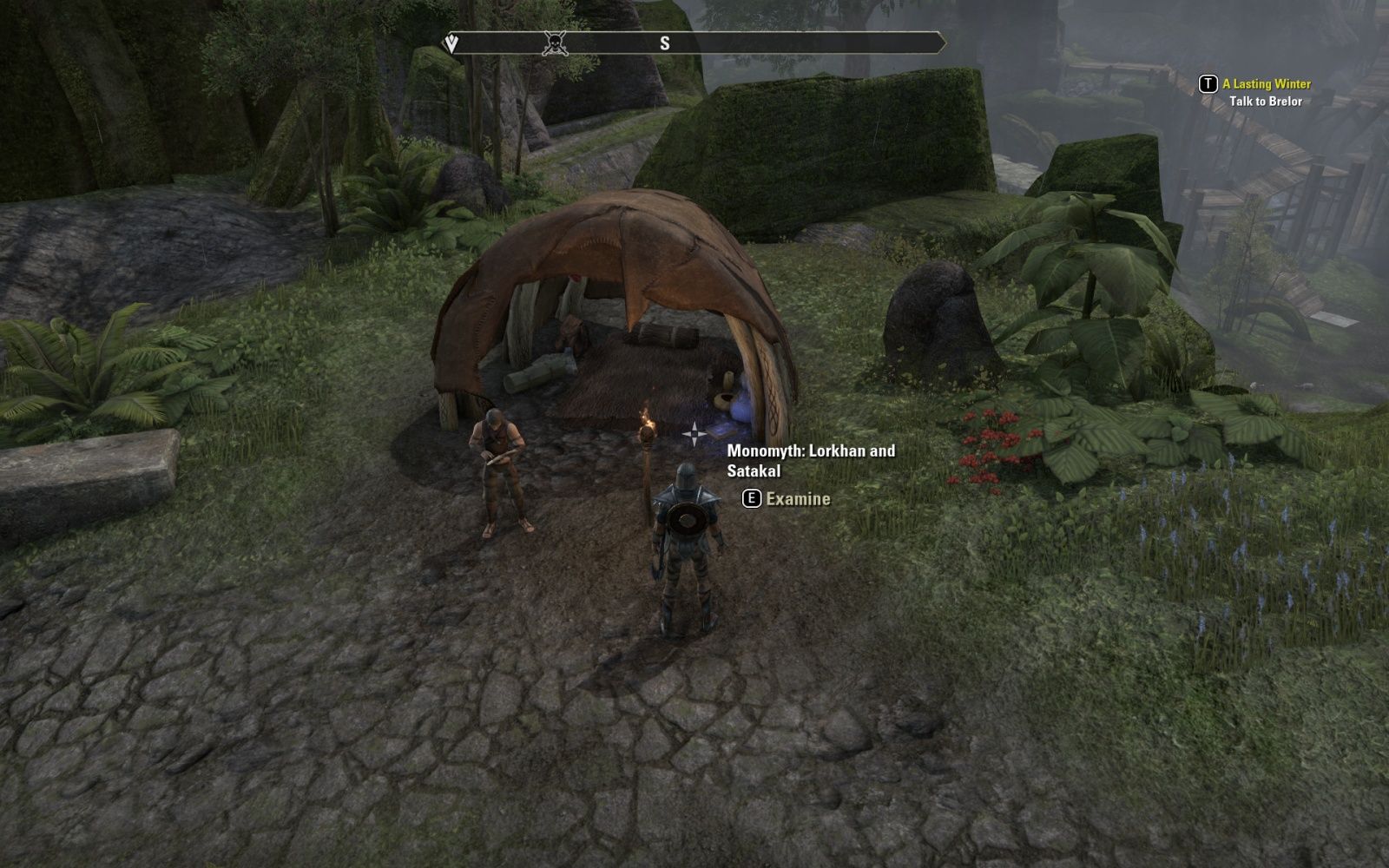
Lorkhan
This Creator-Trickster-Tester deity is in every Tamrielic mythic tradition. His most popular name is the Aldmeri "Lorkhan," or Doom Drum. He convinced or contrived the Original Spirits to bring about the creation of the Mortal Plane, upsetting the status quo much like his father Padomay had introduced instability into the universe in the Beginning Place. After the world is materialized, Lorkhan is separated from his divine center, sometimes involuntarily, and wanders the creation of the et'Ada. Interpretations of these events differ widely by culture. Below is one of the better known.
Yokudan, "Satakal the Worldskin"
"Satak was First Serpent, the Snake who came Before, and all the worlds to come rested in the glimmer of its scales. But it was so big there was nothing but, and thus it was coiled around and around itself, and the worlds to come slid across each other but none had room to breathe or even be. And so the worlds called to something to save them, to let them out, but of course there was nothing outside the First Serpent, so aid had to come from inside it, and this was Akel, the Hungry Stomach. Akel made itself known, and Satak could only think about what it was, and it was the best hunger, so it ate and ate. Soon there was enough room to live in the worlds and things began. These things were new and they often made mistakes, for there was hardly time to practice being things before. So most things ended quickly or were not good or gave up on themselves. Some things were about to start, but they were eaten up as Satak got to that part of its body. This was a violent time.
"Pretty soon Akel caused Satak to bite its own heart and that was the end. The hunger, though, refused to stop, even in death, and so the First Serpent shed its skin to begin anew. As the old world died, Satakal began, and when things realized this pattern so did they realize what their part in it was. They began to take names, like Ruptga or Tu'whacca, and they strode about looking for their kin. As Satakal ate itself over and over, the strongest spirits learned to bypass the cycle by moving at strange angles. They called this process the Walkabout, a way of striding between the worldskins. Ruptga was so big that he was able to place the stars in the sky so that weaker spirits might find their way easier. This practice became so easy for the spirits that it became a place, called the Far Shores, a time of waiting until the next skin.
"Ruptga was able to sire many children through the cycles, and so he became known as the Tall Papa. He continued to place stars to map out the void for others, but after so many cycles, there were almost too many spirits to help out. He made himself a helper from the detritus of past skins, and this was Sep, or the Second Serpent. Sep had much of the Hungry Stomach still left in him, multiple hungers from multiple skins. He was so hungry he could not think straight. Sometimes he would just eat the spirits he was supposed to help, but Tall Papa would always reach in and take them back out. Finally, tired of helping Tall Papa, Sep went and gathered the rest of the old skins and balled them up, tricking spirits to help him, promising them this was how you reached the new world, by making one out of the old. These spirits loved this way of living, as it was easier. No more jumping from place to place. Many spirits joined in, believing this was good thinking. Tall Papa just shook his head.
"Pretty soon the spirits on the skin-ball started to die, because they were very far from the real world of Satakal. And they found that it was too far to jump into the Far Shores now. The spirits that were left pleaded with Tall Papa to take them back. But grim Ruptga would not, and he told the spirits that they must learn new ways to follow the stars to the Far Shores now. If they could not, then they must live on through their children, which was not the same as before. Sep, however, needed more punishment, and so Tall Papa squashed the Snake with a big stick. The hunger fell out of Sep's dead mouth and was the only thing left of the Second Serpent. While the rest of the new world was allowed to strive back to godhood, Sep could only slink around in a dead skin, or swim about in the sky, a hungry void that jealously tried to eat the stars."
Lorkhan
Ce dieu fourbe et créateur se retrouve dans toutes les religions de Tamriel. Son nom le plus commun est Lorkhan ou ? Tambour du Destin ? en aldméri. C'est lui qui a convaincu les esprits originels de créer le monde des mortels (ou qui est parvenu ? ses fins en les trompant), tout comme son p?re, Padomay, avait fait naître l'instabilité au Lieu du Commencement. Une fois le monde créé, Lorkhan se retrouve généralement privé de son statut divin ? parfois contre sa volonté, selon la religion dans laquelle il apparaît ? et parcourt alors les terres des Et'Adas. Il convient cependant de noter que l'interprétation de ces événements varie considérablement selon les civilisations ; vous trouverez ci-dessous la plus répandue.
Mythe yokudan, ? Satakal, la peau du monde ?
? Satak était le Premier serpent, le Serpent qui est venu avant, et tous les mondes ? venir étaient nichés dans l'éclat de ses écailles. Mais il était si gros que rien d'autre ne pouvait exister. Enroulé sur lui-m?me, les mondes ? venir glissaient sur lui sans qu'aucun n'ait la place de se former. Alors, les mondes voulurent que quelque chose les lib?re, mais il n'existait rien d'autre que le Premier serpent. Il fallait donc que l'aide provienne de lui. Ce fut Akel, l'Estomac affamé, qui se manifesta, et Satak ne put bientôt plus songer qu'? lui. La faim s'empara ainsi de lui, et il mangea et mangea encore. Bientôt, les mondes eurent assez de place pour naître et moult choses apparurent. Ces changements furent souvent source d'erreurs, car il n'existait rien avant eux pour les guider. Aussi, la plupart de ces créations disparurent rapidement ou furent dévorées par Satak avant d'avoir pu évoluer. Ce fut une ?re de violence.
?Akel poussa rapidement Satak ? mordre son propre c?ur et ce fut la fin. Mais m?me dans la mort, la faim ne cessa pas pour autant. Le Premier serpent mua alors pour renaître. Statakal naquit ainsi sur les ruines de l'ancien monde. Quand les choses le constat?rent, elles comprirent quelle était leur place. Elles prirent des noms comme Ruptga ou Tu'whacca, et partirent en qu?te de leurs semblables. Alors que Satakal se dévorait lui-m?me encore et encore, les esprits les plus puissants apprirent ? échapper ? ce cycle éternel en empruntant des angles inconnus pour se glisser entre les peaux du monde. L'Errance était née. Ruptga devint ensuite si gros qu'il fut capable de placer les étoiles dans le ciel pour faciliter l'Errance des esprits faibles. C'est seulement ensuite que furent engendrées les Rives lointaines afin que les esprits puissent trouver le repos entre chaque peau.
? Ruptga donna naissance ? de nombreux enfants entre chaque cycle, ce qui lui valut le nom de Haut p?re. Il continua également ? placer des étoiles pour indiquer le chemin ? suivre, mais apr?s tant de cycles, le nombre d'esprits était devenu trop important. Il récupéra alors les peaux des anciennes mues pour donner naissance ? Sep, le Second serpent. Mais Sep n'était pas délivré de la faim dévorante des anciennes mues, et sa raison en fut altérée. Il lui arrivait ainsi de dévorer les esprits qu'il voulait aider, forçant le Haut p?re ? les sauver en les extirpant de son estomac. Lassé d'aider ce dernier, Sep réunit le reste des anciennes peaux et en fit une sph?re grâce ? l'aide d'esprits ? qui il affirma que le nouveau monde devait naître de l'ancien. Ces esprits furent séduits par une telle simplicité. Plus jamais ils n'auraient ? errer d'un endroit ? un autre et nombreux furent ceux qui se joignirent ? lui, tandis que le Haut p?re se contenta de secouer la t?te.
?Tr?s vite, les esprits de la sph?re de peaux dépérirent, car ils étaient tr?s loin du vrai monde de Satakal. Ils découvrirent également ne pouvaient plus atteindre les Rives lointaines. Les esprits restants suppli?rent alors le Haut p?re de les faire revenir. Mais le cruel Ruptga refusa en leur disant qu'ils devraient désormais découvrir de nouvelles mani?res pour suivre les étoiles jusqu'aux Rives lointaines. S'ils s'en révélaient incapables, il leur faudrait vivre au travers de leurs enfants. Sep, cependant, devait ?tre puni. Le Haut p?re frappa donc le serpent avec un gros bâton. La faim fut arrachée de sa bouche et ce fut l'ultime défaite du Second serpent. Et tandis que le reste du nouveau monde fut autorisé ? partir en qu?te de son statut divin perdu, Sep fut contraint d'endosser une peau morte ou de nager dans le ciel sous la forme d'un vide affamé tentant de dévorer les étoiles.
Lorkhan
Diese Gottheit tritt als Schöpfer, Schwindler und Prüfer auf und findet sich in jeder mythischen Tradition Tamriels. Sein beliebtester Name ist das aldmerische ?Lorkhan? für ?Untergangstrommel?. Er hat die Ursprünglichen Geister überzeugt oder überlistet, die Ebene der Sterblichen zu erschaffen. Damit kippte Lorkhan das Gleichgewicht des Kosmos, wie schon sein Vater Padomay vor ihm, als dieser dem Universum Instabilität brachte. Nachdem die Welt Form gewinnt, löst sich Lorkhan von seiner göttlichen Mitte (je nach Variante der Geschichte unfreiwillig) und durchstreift anschließend ruhelos die Schöpfung der et'Ada. Die Deutungen dieser Ereignisse unterscheiden sich in den Kulturen erheblich voneinander. Es folgt eine der bekanntesten.
Yokudanisch: ?Satakal, die Weltenhaut?
?Satak war die Erste Schlange, die Schlange, die vor allem anderen kam, und alle Welten ruhten im Glanz ihrer Schuppen. Aber sie war so gewaltig, dass es nichts außer ihr gab, und daher schlang sie sich immer und immer wieder um sich selbst, und die Welten glitten übereinander, aber keine hatte Platz zum Atmen oder auch nur zum Sein. Und so riefen die Welten nach jemandem, der sie rettet, der sie befreite, aber natürlich gab es nichts außer der Ersten Schlange. Also musste die Hilfe aus dem Inneren der Schlange kommen. Diese Hilfe war Akel, der Hungrige Magen. Akel machte sich bemerkbar, und Satak konnte nur daran denken, was er war, und er war der beste Hunger, und so fraß und fraß sie. Bald war genug Platz, und es konnte Leben auf den Welten geben. So begannen die Dinge. Diese Dinge waren neu und machten oft Fehler, da sie kaum Übung darin hatten, Dinge zu sein. Also waren die meisten Dinge schnell am Ende oder nicht gut oder ohne Lebenswillen. Einige Dinge wollten beginnen, aber sie wurden gefressen, als Satak zu diesem Teil seines Körpers kam. Dies war eine Zeit voller Gewalt.
Es dauerte nicht lange, da brachte Akel Satak dazu, sich selbst in den Kopf zu beißen. Das war das Ende. Jedoch war auch der Tod nicht das Ende des Hungers, und so streifte die Erste Schlange ihre Haut ab und begann von Neuem. Mit dem Tod der alten Welt begann Satakal, und als die Dinge dieses Muster erkannten, erkannten sie auch, welche Rolle sie bei all dem spielten. Sie fingen an, sich Namen zu geben, wie Ruptga oder Tu'whacca, und sie machten sich auf die Suche nach Ihresgleichen. Als Satakal sich immer und immer wieder selbst verschlang, lernten die stärksten Geister, den Zyklus zu umgehen, indem sie sich in seltsamen Winkeln bewegten. Sie nannten diesen Vorgang den ?Weltengang?, und so reisten sie zwischen den Weltenhäuten. Ruptga war so groß, dass er die Sterne ins Firmament hängen konnte, die schwächeren Geistern den Weg weisen sollten. Dies wurde für die Geister so einfach, dass daraus ein Ort entstand: An den Fernen Ufern wartete man nun auf die nächste Haut.
Ruptga konnte während der Zyklen zahlreiche Kinder zeugen, und so wurde er als der Große Vater bekannt. Er hängte weiter Sterne ins Nichts, um anderen den Weg zu weisen, aber nach so vielen Zyklen gab es fast schon zu viele Geister, denen geholfen werden musste. Er erschuf sich einen Helfer aus den Überresten vergangener Häute, und er nannte ihn Sep, die Zweite Schlange. Sep hatte noch viel vom Hungrigen Magen in sich, mehrere Hunger mehrerer Häute. Sie war so hungrig, dass sie nicht klar denken konnte. Manchmal verschlang sie die Geister, denen sie helfen sollte, aber der Große Vater zog sie stets wieder aus ihrem Schlund. Schließlich hatte Sep es satt, dem Großen Vater zu helfen. Sie sammelte den Rest der alten Häute und formte eine Kugel daraus; dabei halfen ihr Geister, denen sie versprach, dass sie eine neue Welt erreichen konnten, indem sie aus der alten eine neue machten. Diesen Geistern gefiel diese Art zu leben, da sie einfacher war. Nie mehr müssten sie von Ort zu Ort springen. Viele Geister halfen mit, im Glauben, dass es nur logisch sei. Der Große Vater schüttelte nur seinen Kopf.
Schon bald starben die Geister auf dem Hautball, da sie sehr weit entfernt waren von der wirklichen Welt von Satakal. Und sie stellten fest, dass die Entfernung zu den Fernen Ufern jetzt zu groß für einen Sprung war. Die verbliebenen Geister flehten den Großen Vater an, sie zurückzuholen. Aber der grimmige Ruptga weigerte sich, und er sagte den Geistern, dass sie von nun an neue Wege erlernen müssten, um den Sternen zu den Fernen Ufern zu folgen. Andernfalls müssten sie durch ihre Kinder weiterleben, was nicht dasselbe war wie zuvor. Sep jedoch gebührte mehr Strafe, und der Große Vater erschlug die Schlange mit einem großen Stock. Der Hunger fiel aus Seps totem Maul; er war alles, was von der Zweiten Schlange übrig blieb. Während der Rest der neuen Welt weiter nach Göttlichkeit streben durfte, konnte Sep nur in einer toten Haut herumkriechen oder am Himmel herumschwimmen als hungriges Nichts, das vor Eifersucht versucht, die Sterne zu verschlingen.?

 Monomythe : Lorkhan et Satakal
 Monomythos: Lorkhan und Satakal